Bilateral prepapillary vascular loops in a pediatric patient
Article Sidebar
Main Article Content
Abstract
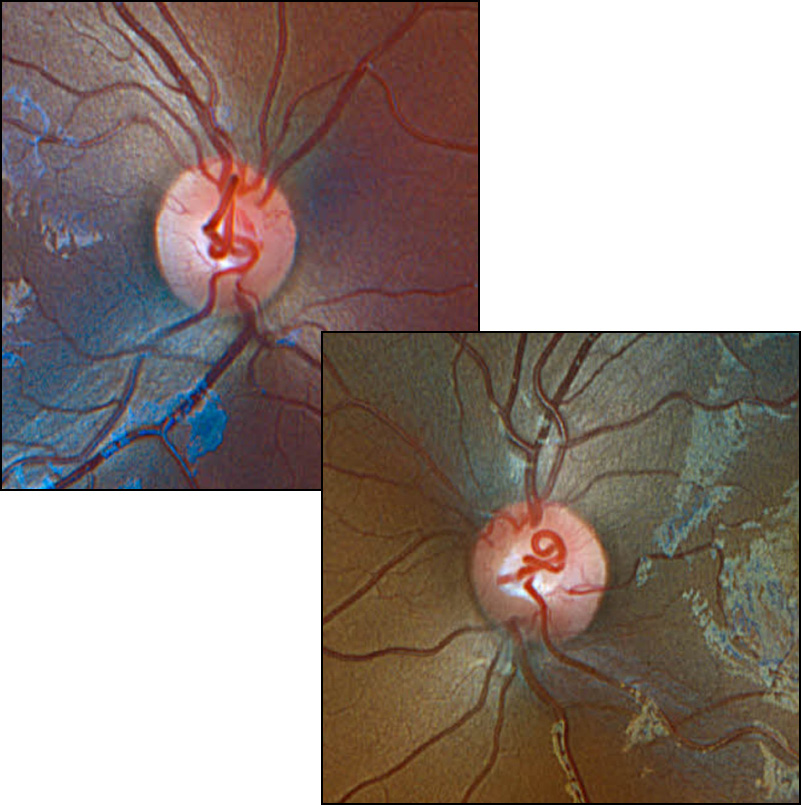
Prepapillary vascular loops are a congenital vascular anomaly in which irregular vessels emerge from the optic disc and project into the vitreous cavity. The “loops” are unusually elongated and may display elevation, coiling, and even a corkscrew or figure-eight appearance. This abnormal vascular morphogenesis is most commonly arterial in origin; however, venous or arteriovenous involvement is also possible. Bilateral presentation is rare. Peripapillary loops are typically asymptomatic and discovered incidentally on routine fundus examination. The figure shows color fundus photography and optical coherence tomography of bilateral prepapillary vascular loops in a 12-year-old healthy boy who presented for a standard ophthalmologic evaluation. Potential complications of prepapillary vascular loops include vitreous hemorrhage, amaurosis fugax, subretinal hemorrhage, or retinal artery/vein occlusion. Clinical management is generally conservative, because the condition is benign and rarely progresses. Additional diagnoses to consider include neovascularization of the disc and vascular collaterals. Prepapillary vascular loops are distinguished from these entities by their congenital, nonprogressive nature, distinct vascular morphology, and clinical presentation.
Downloads
Article Details

This work is licensed under a Creative Commons Attribution-NonCommercial-NoDerivatives 4.0 International License.