A previously unreported RPGR gene variant in a female patient with X-linked retinitis pigmentosa
Article Sidebar
Main Article Content
Abstract
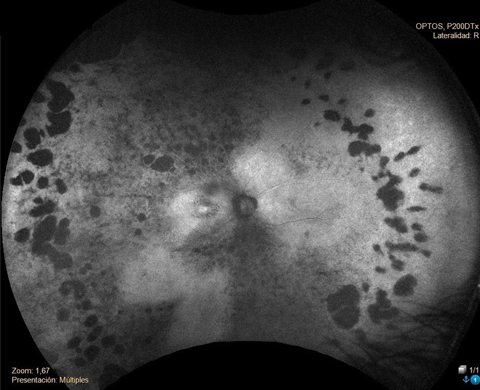
We present the case of a 40-year-old woman with a history of high myopia and nyctalopia. Her best-corrected visual acuity was 20/80 in the right eye and 20/100 in the left eye. Fundus examination revealed generalized vascular attenuation, optic nerve pallor, and bone spicule pigmentation. Fundus autofluorescence in both eyes showed a Robson-Holder ring in the macula and multiple hypoautofluorescent lesions in the peripheral retina. Macular optical coherence tomography scans revealed a generalized thinning of retinal layers, with atrophy of the outer retinal layers. 10-2 visual fields revealed a small island of central vision in both eyes, and full field electroretinogram showed absence of scotopic and photopic responses. Genetic studies documented a rare variant in the RPGR gene (c.1991C>G p.(Ser664*)). Findings compatible with retinitis pigmentosa in our patient suggests that this mutation is pathogenic. Further study is required to confirm this hypothesis.
Downloads
Article Details

This work is licensed under a Creative Commons Attribution-NonCommercial-NoDerivatives 4.0 International License.




References
Kortüm F, Kieninger S, Mazzola P, et al. X-linked retinitis pigmentosa caused by non-canonical splice site variants in RPGR. Int J Mol Sci 2021;22:850. DOI: https://doi.org/10.3390/ijms22020850
Verbakel SK, van Huet RAC, Boon CJF, et al. Non-syndromic retinitis pigmentosa. Prog Retin Eye Res 2018;66:157-86. DOI: https://doi.org/10.1016/j.preteyeres.2018.03.005
Salvetti AP, Nanda A, MacLaren RE. RPGR-related X-linked retinitis pigmentosa carriers with a severe “male pattern.” Ophthalmologica 2021;244:60-7. DOI: https://doi.org/10.1159/000503687
Cehajic-Kapetanovic J, Xue K, Martinez-Fernandez de la Camara C, et al. Initial results from a first-in-human gene therapy trial on X-linked retinitis pigmentosa caused by mutations in RPGR. Nat Med 2020;26:354-9. DOI: https://doi.org/10.1038/s41591-020-0763-1
Gocuk SA, Jolly JK, Edwards TL, Ayton LN. Female carriers of X-linked inherited retinal diseases – genetics, diagnosis, and potential therapies. Prog Retin Eye Res 2023;96:101190. DOI: https://doi.org/10.1016/j.preteyeres.2023.101190
Pinheiro I, Heard E. X chromosome inactivation: new players in the initiation of gene silencing. F1000Res 2017;6:F1000 Faculty Rev-344. DOI: https://doi.org/10.12688/f1000research.10707.1
Sun Z, Fan J, Wang Y. X-Chromosome inactivation and related diseases. Genet Res (Camb) 2022;2022:1391807. DOI: https://doi.org/10.1155/2022/1391807
Lyraki R, Megaw R, Hurd T. Disease mechanisms of X-linked retinitis pigmentosa due to RP2 and RPGR mutations. Biochem Soc Trans 2016;44:1235-44. DOI: https://doi.org/10.1042/BST20160148
Sayo A, Ueno S, Kominami T, et al. Longitudinal study of visual field changes determined by Humphrey Field Analyzer 10-2 in patients with retinitis pigmentosa. Sci Rep 2017;7:1-8. DOI: https://doi.org/10.1038/s41598-017-16640-7
Nguyen XTA, Moekotte L, Plomp AS, Bergen AA, van Genderen MM, Boon CJF. Retinitis pigmentosa: current clinical management and emerging therapies. Int J Mol Sci 2023;24:7481. DOI: https://doi.org/10.3390/ijms24087481
Vervoort R, Wright AF. Mutations of RPGR in X-linked retinitis pigmentosa (RP3). Hum Mutat 2002;19:486-500. DOI: https://doi.org/10.1002/humu.10057
Sladen PE, Naeem A, Adefila-Ideozu T, et al. AAV-RPGR gene therapy rescues opsin mislocalisation in a human retinal organoid model of -associated X-Linked Retinitis Pigmentosa. Int J Mol Sci 2024;25:1839. DOI: https://doi.org/10.3390/ijms25031839