Comparing tolerability and outcomes of cryopreserved and dehydrated amniotic membrane transplantations in the management of corneal disease
Article Sidebar
Main Article Content
Abstract
Purpose
To investigate the clinical outcomes of dehydrated versus cryopreserved amniotic membrane transplantation for corneal disease.
Methods
Clinical data from 56 patients were analyzed retrospectively, including indications for treatment, number of amniotic membrane transplant (AMT) interventions, duration of therapy, use of adjunct medications, visual outcomes, and transplant tolerability. To analyze patient transplant tolerability, medical records were reviewed for relevant keywords at 1 week and 1 month after implantation.
Results
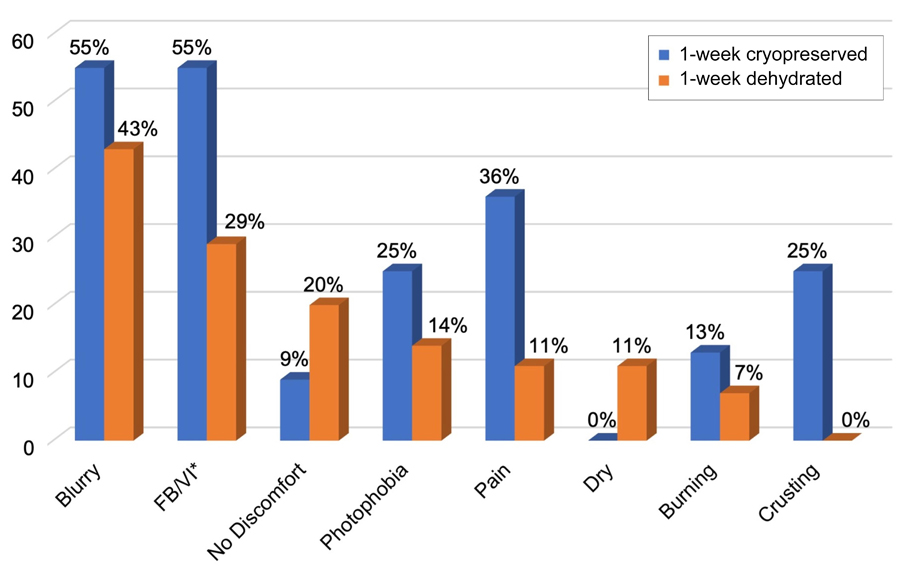
A total of 71 AMTs of 56 patients were included. At both follow-up time points, patients who received a cryopreserved amniotic membrane transplant (CAMT) reported more side effects than did patients who received a dehydrated amniotic membrane transplant (DAMT). Those in the CAMT group also reported greater improvement in vision and a greater feeling of wellness at both intervals compared with patients in the DAMT group. Patients in the DAMT were less likely to require repeat treatments and achieved a higher percent resolution of the primary indication.
Conclusions
In our study cohort, cryopreserved amniotic membranes appear to provide greater patient satisfaction, whereas dehydrated membranes appear to provide better clinical outcomes, with less need for repeat treatment. Because of limitations in stratifying disease severity, it cannot be concluded without a prospective cohort trial that the need for repeat treatment is not due to more severe disease in the cryopreserved group.
Downloads
Article Details

This work is licensed under a Creative Commons Attribution-NonCommercial-NoDerivatives 4.0 International License.




References
Hatzfeld AS, Pasquesoone L, Germain N, et al. Benefits of cryopreserved human amniotic membranes in association with conventional treatments in the management of full-thickness burns. Int Wound J 2019;16:1354-64.
Magatti M, Vertua E, De Munari S, et al. Human amnion favours tissue repair by inducing the M1-to-M2 switch and enhancing M2 macrophage features. J Tissue Eng Regen Med 2017;11:2895-2911.
Allen CL, Clare G, Stewart EA, et al. Augmented dried versus cryopreserved amniotic membrane as an ocular surface dressing. PLoS One 2013;8:e78441.
Withavatpongtorn N, Tuntivanich N. Characterization of cryopreserved canine amniotic membrane. Membranes (Basel) 2021;11:824.
Cooke M, Tan EK, Mandrycky C, He H, O’Connell J, Tseng SC. Comparison of cryopreserved amniotic membrane and umbilical cord tissue with dehydrated amniotic membrane/chorion tissue. J Wound Care 2014;23:465-76.
Huffer S. ROB Power Packs 2016: Medical Eyecare. Rev Optom Bus. December 23, 2016.
You IC, Coursey TG, Bian F, Barbosa FL, de Paiva CS, Pflugfelder SC. Macrophage phenotype in the ocular surface of experimental murine dry eye disease. Arch Immunol Ther Exp (Warsz) 2015;63:299-304.