Effects of digital screen property modification on symptoms of digital eye strain
Article Sidebar
Main Article Content
Abstract
Purpose
To evaluate whether use of digital screen color temperature–modulating software is associated with changes in severity of symptoms associated with digital eye strain.
Methods
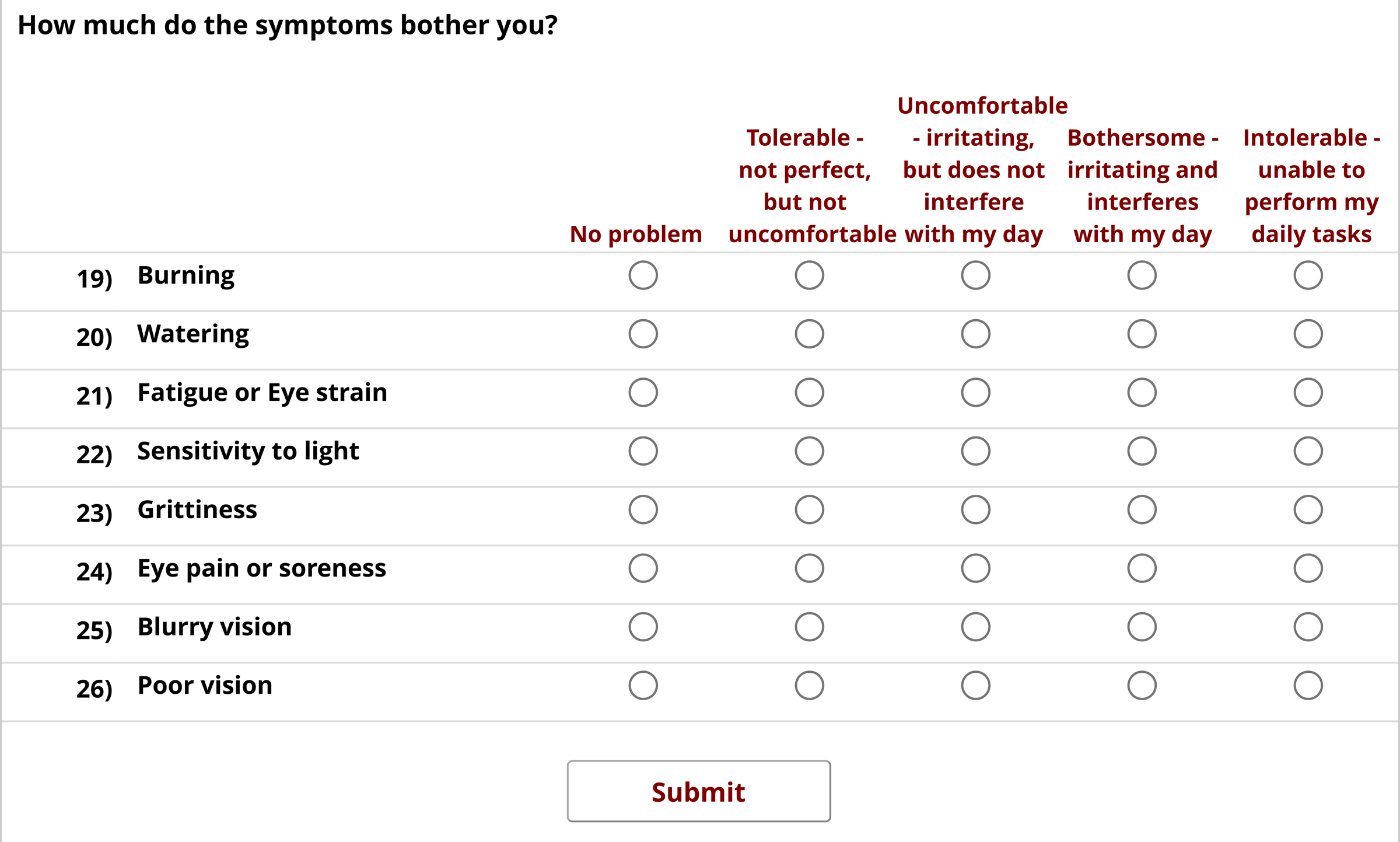
In this prospective, interventional study, participants were recruited at ophthalmology clinics and via email. Participants completed a pre-intervention survey regarding demographics, digital screen use patterns, and severity of eight digital eye strain symptoms on a five-point Likert scale. Participants were randomized to use color temperature modulating software, reduce digital screen brightness, or change no digital screen properties on their personal computers for 1 month, after which time participants completed a post-intervention survey on digital eye strain symptom severity and adherence to intervention use. Changes in symptom severity scores were assessed using paired t tests.
Results
Pre-intervention and post-intervention questionnaires were completed by 47 participants. There was no significant difference in computer screen use times and baseline symptom severity across groups. Regarding usability, 19/19 participants (100%) in the color temperature modulation group and 16/17 (94%) in the brightness reduction group used the intervention half the time or more. In the brightness reduction group, there was a significant reduction in the eye fatigue severity score by 0.82 (P = 0.0007). There was no significant reduction in symptom severity in the color temperature modulation and control groups.
Conclusions
In our study cohort, digital screen color temperature modulating software was associated with a high level of usability but was not associated with a reduction in digital eye strain symptom severity.
Downloads
Article Details

This work is licensed under a Creative Commons Attribution-NonCommercial-NoDerivatives 4.0 International License.




References
Bahkir FA, Grandee SS. Impact of the COVID-19 lockdown on digital device-related ocular health. Indian J Ophthalmol 2020;68:2378-83.
Xiang M, Zhang Z, Kuwahara K. Impact of COVID-19 pandemic on children and adolescents' lifestyle behavior larger than expected. Prog Cardiovasc Dis 2020;63:531-2.
Singh S, Downie LE, Anderson AJ. Do blue-blocking lenses reduce eye strain from extended screen time? a double-masked randomized controlled trial. Am J Ophthalmol 2021;226:243-51.
Sheppard AL, Wolffsohn JS. Digital eye strain: prevalence, measurement and amelioration. BMJ Open Ophthalmol 2018;3:e000146.
Mehra D, Galor A. Digital screen use and dry eye: a review. Asia Pac J Ophthalmol (Phila) 2020;9:491-7.
Taylor HR, West S, Muñoz B, Rosenthal FS, Bressler SB, Bressler NM. The long-term effects of visible light on the eye. Arch Ophthalmol 1992;110:99-104.
Rosenfield M, Li RT, Kirsch NT. A double-blind test of blue-blocking filters on symptoms of digital eye strain. Work 2020;65:343-8.
Palavets T, Rosenfield M. Blue-blocking filters and digital eyestrain. Optom Vis Sci 2019;96:48-54.
Schiffman RM, Christianson MD, Jacobsen G, Hirsch JD, Reis BL. Reliability and validity of the Ocular Surface Disease Index. Arch Ophthalmol 2000;118:615-21.
Ngo W, Situ P, Keir N, Korb D, Blackie C, Simpson T. Psychometric properties and validation of the Standard Patient Evaluation of Eye Dryness questionnaire. Cornea 2013;32:1204-10.
Zayed HAM, Saied SM, Younis EA, Atlam SA. Digital eye strain: prevalence and associated factors among information technology professionals, Egypt. Environ Sci Pollut Res Int 2021;28:25187-95.
Al Tawil L, Aldokhayel S, Zeitouni L, Qadoumi T, Hussein S, Ahamed SS. Prevalence of self-reported computer vision syndrome symptoms and its associated factors among university students. Eur J Ophthalmol 2020;30:189-95.
Kaur K, Gurnani B, Nayak S, et al. Digital eye strain—a comprehensive review. Ophthalmol Ther 2022;11:1655-80.
Talens-Estarelles C, Cerviño A, García-Lázaro S, Fogelton A, Sheppard A, Wolffsohn JS. The effects of breaks on digital eye strain, dry eye and binocular vision: testing the 20-20-20 rule. Cont Lens Anterior Eye 2022:101744.
Galinsky T, Swanson N, Sauter S, Dunkin R, Hurrell J, Schleifer L. Supplementary breaks and stretching exercises for data entry operators: a follow-up field study. Am J Ind Med 2007;50:519-27.
Balci R, Aghazadeh F. The effect of work-rest schedules and type of task on the discomfort and performance of VDT users. Ergonomics 2003;46:455-65.