3-D presentation of calibration data of a perimetry eye tracker
Article Sidebar
Main Article Content
Abstract
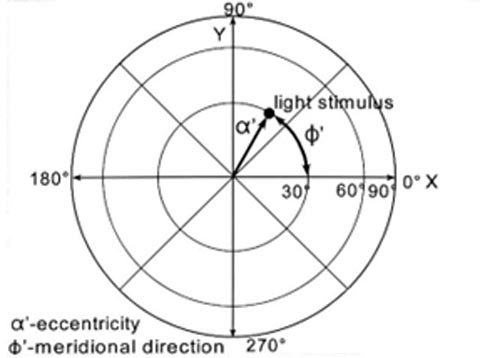
A calibration method for eye movements monitoring in standard and objective static perimeters is described. Current static perimeters require the subjects to maintain steady fixation during the entire examination. By implementing eye tracking methods adopted for perimetry, automatic fixation monitoring is possible during perimetrical test. Successful fixation monitoring allows conditional eye movements. An important issue in designing a fixation monitoring unit is the method of initial eye tracker calibration. The aim of this study is to demonstrate an alternative way to present the eye tracker calibration data in a three dimensional coordinate system. The resulting figure allows precise and fast calibration data assessment. The calibration method is based on an analysis of the distance between the images of the corneal reflection and the pupil center for calibration points at specific locations. The method provides an accuracy of 1deg. in calculating the fixation point for +/- 20 deg. eccentricities of the line-of-sight relative to the center of the perimeter by using 8 calibration points and could be expanded to any other view field by using more calibration points. The calibration procedure can be completed in under 1 minute. The required time depends on the patient's ability to concentrate. The model is subject specific and once calculated it can be used in multiple recording sessions. Based on the perimeter's polar coordinate system this model is particularly suitable for implementation in perimetry, however, it can easily be adopted in eye testing equipment with different setups.
Downloads
Article Details

This work is licensed under a Creative Commons Attribution-NonCommercial-NoDerivatives 4.0 International License.
References
Anderson K, Iles G, Smith K, Llewellyn-Thomas E. An eye-position controlled typewriter. Digest of the Int Conference on Medical and Biological Engineering Ottawa. Vol. 1. 1976:410-411.
Barbur J, Thomson W, Forsyth P. A new system for the simultaneous measurement of pupil size and two-dimensional eye movements. Clin Vis Sci 1987;2:131-142.
David S, Joshua B. The goal of eye position measurement instrumentation. Eye Movements: Cognition and Visual Perception. Hillsdale, NJ: Erlbaum; 1981.
Demasco P. The development of a non-contact eyetracking system for communications and control. RESNA 87, Meeting the Challenge, Proceedings of the 10th Annual Conference on Rehabilitation Technology. San Jose; 1987:688-690.
Drasdo N, Fowler C. Non-linear projection of the retinal image in a wide-angle schematic eye. B J Ophthalmol 1974;58:709-714.
Heiland L. Ein Beitrag zur Realisierung eines mikrorechnergestützten Messverfahrens zur automatischen Reizortüberwachung für die Elektroperimetrie. Dissertation A, Technische Hochschule Ilmenau, Fakultaet für Technische Wissenschaften, 1984.
Henning G. Methodische und technische Optimierung der objektiven Perimetrie, Dissertation B. Technische Hochschule Ilmenau, Fakultaet für Technische Wissenschaften. 1980.
Heynen J, Kahm D. An eye transducer for keyboard emulation. IEEE Global Telecommunications Conf, New Orleans, USA. 1985:1063-1065.
Jean B, Kazmierczak H, Grunert Th, Thiel H-J. Echtzeit-Eye Tracking—Grundlagen und Lösungsprinzipien. Klin Mbl Augenheilk. Stuttgart: F. Enke Verlag 1991;198:S.538-543.
Johnston S. et al. Computerised visual field test for children using multiple moving fixation targets, Med Biol Eng Comput 1989;27:612-616.
LC Technologies Inc. The Eyegaze Development System: a tool for human factors applications. 1992.
Loshin D, Juday R. The programmable remapper, clinical applications for patients with field defects, Optometry and Vision Sci 1989;66:389-395.
Menozzi M, v Buol A, Krueger H. Messbrille zur Erfassung von Augen-, Kopfbewegungen und Pupillendurchmesser. Biomedizinische Technik 1991;36(10): S.253-259.
Merchant J, Morrissette R, Porterfield J. Remote measurement of eye direction allowing subject motion over one cubic foot of space. IEEE Trans Biomed Eng 1974;21(4):309-17.
Mutlukan E, Damato BE. Computerised perimetry with moving and steady fixation in children. Eye 1993;7:554-561.
Müller W, Haase E, Henning G, Berndt R. Untersuchungen zur objektiven Perimetrie. Albrecht Von Graefes Arch Klin Exp Ophthal 1974;190:S.329-340.
Yasui S, Young L. On the predictive control of foveal eye tracking and slow phases of optokinetic and vestibular nystagmus. J Physiol 1982;347:17-33.
Young L, Sheena D. Methods & designs: survey of eye movement recording methods. Behav Res Methods Instrument 1975;7:397-429.