Subconjunctival Loa loa worm
Article Sidebar
Main Article Content
Abstract
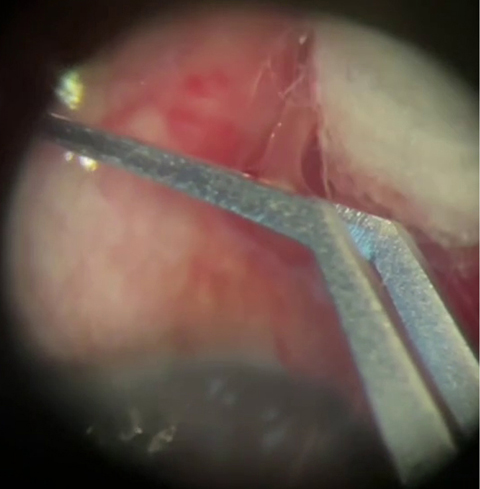
A 50-year-old woman presented emergently at The Western Eye Hospital with a 2-day history of right eye pain, redness, and sensation of foreign body movement in her eye. She reported having traveled to the Democratic Republic of Congo 1 year prior and recalled developing a skin lesion following an insect bite. Examination revealed mild conjunctival hyperemia and a motile, subconjunctival nematode. There was no fundus pathology. To slow down the parasite’s movement, topical tetracaine 1% and pilocarpine 2% eye drops were used. Subconjunctival anesthesia was avoided, because swelling of the conjunctiva and Tenon’s tissue would have made visualizing the parasite difficult. The nematode was removed from Tenon’s capsule (Video) and was later confirmed to be an adult female Loa loa worm. Loiasis is caused by injection of Loa loa microfilariae into human blood via the fly’s proboscis. The microfilariae mature in the host skin but can circulate to other tissues, including the eyes. In our patient, blood smear confirmed the presence of microfilariae, and systemic treatment with diethylcarbamazine was commenced. This case highlights the importance of detailed history taking, including travel to locations where parasites are endemic.
Downloads
Article Details

This work is licensed under a Creative Commons Attribution-NonCommercial-NoDerivatives 4.0 International License.