Artemis very high-frequency digital ultrasound guided femtosecond laser recut after flap complication
Article Sidebar
Published:
Sep 14, 2014
Main Article Content
Abstract
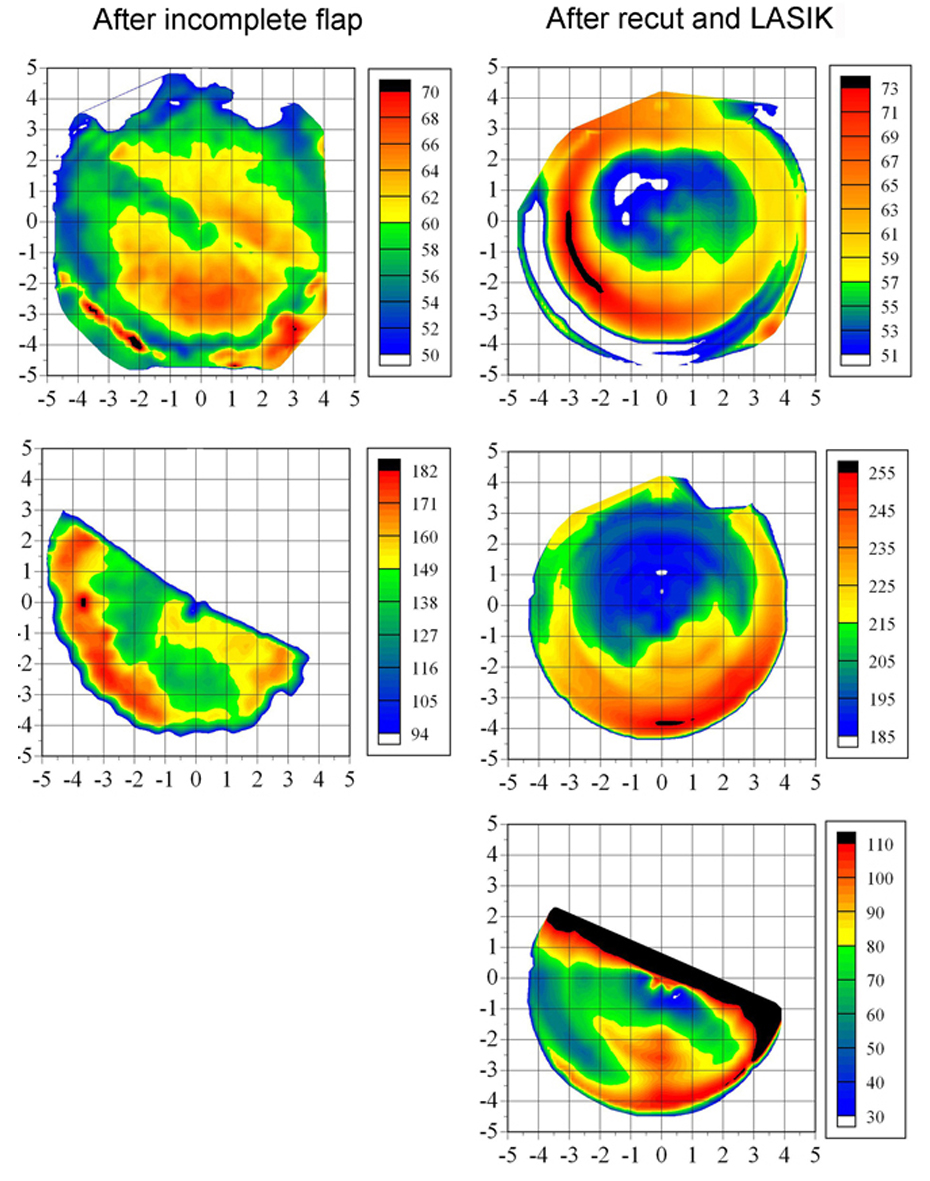
Incomplete flaps are a relatively uncommon complication of laser-assisted in situ keratomileusis (LASIK) that occur when creation of the corneal flap is interrupted. Further complications can arise if a second flap is created that intersects the original flap interface, resulting in tissue slivers that can lead to more complications and poor visual outcomes. We report the case of a 56-year-old man who underwent LASIK in which an incomplete flap occurred after 45% completion using a mechanical microkeratome with a 160 µm head. The maximum depth achieved by this incomplete flap was measured by very high-frequency (VHF) digital ultrasound as 182 µm peripherally. Two months later, a second flap was created beneath the incomplete flap, at a depth of 190 µm. The resulting flap had a central thickness of 196 µm and a minimum clearance of 30 µm beneath the incomplete flap. This demonstrates a method for creating secondary flaps that may significantly reduce the risk of flap interface intersection.
Downloads
Download data is not yet available.
Article Details
How to Cite
1.
Reinstein DZ, Dickeson Z. Artemis very high-frequency digital ultrasound guided femtosecond laser recut after flap complication. Digit J Ophthalmol. 2014;20(3):43-47. doi:10.5693/djo.02.2014.01.003
Issue
Section
Case Reports

This work is licensed under a Creative Commons Attribution-NonCommercial-NoDerivatives 4.0 International License.