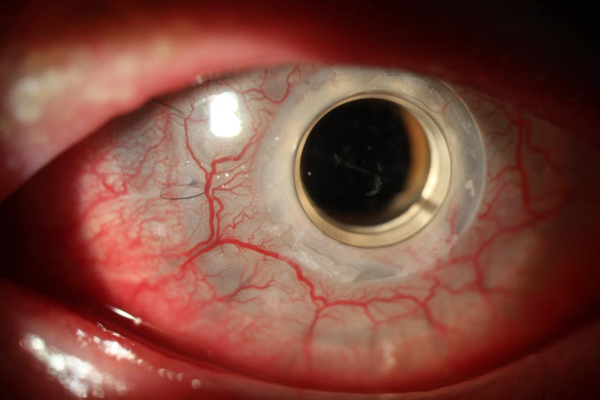
Bilateral Boston Keratoprosthesis for treatment of a variant of keratitis–ichthyosis–deafness syndrome
Article Sidebar
Main Article Content
Abstract
We report the case of a 4-year-old boy diagnosed with keratitis-ichthyosis-deafness (KID) syndrome with long-term follow-up, including multiple surgical and nonsurgical treatments. Genetic testing revealed a missense GJB2 mutation (p.Asp50Asn). His ocular condition deteriorated to the point that, at 37 years of age, he required bilateral keratoprosthesis (KPro) implantation, resulting in best-corrected visual acuity of 20/25 in the right eye and 20/40 in the left eye. Our findings suggest that more advanced cases of KID syndrome may benefit from treatment options that rely less on ocular surface stability, such as KPro implantation, whereas therapies that treat the ocular surface may be preferred in early-stage disease.
Downloads
Article Details

This work is licensed under a Creative Commons Attribution-NonCommercial-NoDerivatives 4.0 International License.




References
Dalamón VK, Buonfiglio P, Larralde M, et al. Connexin 26 (GJB2) mutation in an Argentinean patient with keratitis-ichthyosis-deafness (KID) syndrome: a case report. BMC Med Genet 2016;17:37. DOI: https://doi.org/10.1186/s12881-016-0298-y
Cheung AY, Patel S, Kurji KH, et al. Ocular surface stem cell transplantation for treatment of keratitis-ichthyosis-deafness syndrome. Cornea. 2019;38:123-6. DOI: https://doi.org/10.1097/ICO.0000000000001802
Messmer EM, Kenyon KR, Rittinger O, Kampik A. Ocular manifestations of keratitis-ichthyosis-deafness (KID) syndrome. Ophthalmology 2005;112:e1-e6. DOI: https://doi.org/10.1016/j.ophtha.2004.07.034
Wilson GN, Squires RH, Jr, Weinberg AG. Keratitis, hepatitis, ichthyosis, and deafness: report and review of KID syndrome. Am J Med Genet 1991;40:255-9. DOI: https://doi.org/10.1002/ajmg.1320400302
Alvarez A, del Castillo I, Pera A, et al. De novo mutation in the gene encoding connexin-26 (GJB2) in a sporadic case of keratitis-ichthyosisdeafness (KID) syndrome. Am J Med Genet 2003;117A:89-91. DOI: https://doi.org/10.1002/ajmg.a.10851
Serrano-Ahumada AS, Cortes-González V, González-Huerta LM, et al. Severe phenotype of keratitis-ichthyosis-deafness syndrome with presumed ocular surface squamous neoplasia. Cornea 2018;37:252-4. DOI: https://doi.org/10.1097/ICO.0000000000001387
Patel V, Sun G, Dickman M, et al. Treatment of keratitis ichthyosis- deafness (KID) syndrome in children: a case report and review of the literature. Dermatol Ther 2015;28:89-93. DOI: https://doi.org/10.1111/dth.12192
Sanchez HA, Villone K, Srinivas M, Verselis VK. The D50N mutation and syndromic deafness: altered Cx26 hemichannel properties caused by effects on the pore and intersubunit interactions. J Gen Physiol 2013;142:3-22. DOI: https://doi.org/10.1085/jgp.201310962
Lee Lenis T, Zhang W, Shibayama V, et al. Multimodal corneal imaging of genetically confirmed keratitis-ichthyosis-deafness syndrome. Cornea 2020;39:1446-9. DOI: https://doi.org/10.1097/ICO.0000000000002415
Abdollahi A, Hallaji Z, Esmaili N, et al. KID syndrome. Dermatol Online J 2007;13:11. DOI: https://doi.org/10.5070/D323Z6N4DD
Caceres-Rios H, Tamayo-Sanchez L, Duran-Mckinster C, et al. Keratitis, ichthyosis, and deafness (KID syndrome): review of the literature and proposal of a new terminology. Pediatr Dermatol 1996;13:105-13. DOI: https://doi.org/10.1111/j.1525-1470.1996.tb01414.x
Cammarata-Scalisi F, Willoughby CE, Cárdenas Tadich A, et al. Clinical, etiopathogenic, and therapeutic aspects of KID syndrome. Dermatol Ther 2020;33:e13507. DOI: https://doi.org/10.1111/dth.13507
Brown C, Rowlands M, Lee D, et al. Keratoprosthesis in pediatric keratitis-icthyosiform-deafness syndrome. J AAPOS 2016;20:73-5. DOI: https://doi.org/10.1016/j.jaapos.2015.09.009
Mc Lean K, Bignotti S, Callea M, et al. Ocular phenotype and therapeutic interventions in keratitis-ichthyosis-deafness (KID) syndrome. Ophthalmic Genet 2024;45:16-22. DOI: https://doi.org/10.1080/13816810.2023.2258218
Zarei-Ghanavati M, Liu C. Keratoprosthesis: current choices and future development. Asia Pac J Ophthalmol (Phila) 2019;8:429-31. DOI: https://doi.org/10.1097/APO.0000000000000268
Vaillancourt L, Papanagnu E, Elfekhfakh M, Fadous R, Harissi-Dagher M. Outcomes of bilateral sequential implantation of the Boston keratoprosthesis type 1. Can J Ophthalmol 2017;52:80-84. DOI: https://doi.org/10.1016/j.jcjo.2016.07.018