Silent sicklers and traumatic hyphema: a case to emphasize the importance of questioning the unknown
Article Sidebar
Main Article Content
Abstract
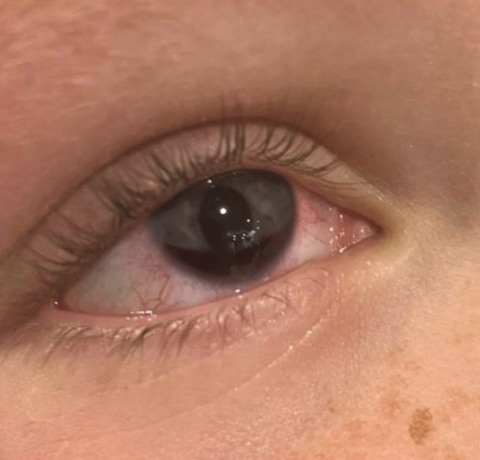
A previously healthy 6-year-old white boy presented emergently after trauma to his right eye. On examination, intraocular pressure (IOP) was 49 mm Hg, and visual acuity was 20/50. He was diagnosed with a 3 mm layering hyphema. Despite medical therapy and lifestyle modifications, the patient’s IOP continued to rise, peaking at 77 mm Hg on day 3 after presentation. Given his elevated IOP despite the addition of new topical medications on daily follow-up, the patient was screened for sickle-cell disease to assess for an underlying pathology that could be exacerbating his elevated IOP. After testing positive for sickle cell trait, the patient was promptly taken to the operating room for anterior chamber washout. The following day, IOP normalized to 14 mm Hg, and visual acuity was 20/25. Hyphemas generally respond well to medical therapy, but patients with sickle cell hemoglobinopathy are at greater risk for permanent vision loss from pressure spikes. This case reinforces the need to collect thorough past medical and family histories and consider early sickle cell screening in all patients failing to respond to IOP-reducing medication or if hemoglobin status is unknown on initial presentation.
Downloads
Article Details

This work is licensed under a Creative Commons Attribution-NonCommercial-NoDerivatives 4.0 International License.
References
American Academy of Ophthalmology. EyeWiki, “Hyphema.” https://eyewiki.org/Hyphema. Accessed September 2, 2024.
Ashorobi D, Ramsey A, Killeen RB, Bhatt R. Sickle cell trait. In: StatPearls. Treasure Island, FL: StatPearls Publishing; 2024. Available at http://www.ncbi.nlm.nih.gov/books/NBK537130/.
Nasrullah A, Kerr NC. sickle cell trait as a risk factor for secondary hemorrhage in children with traumatic hyphema. Am J Ophthalmol 1997;123:783-90.
Sickle Cell Disease – Sickle Cell Trait | NHLBI, NIH. 2024. Available at https://www.nhlbi.nih.gov/health/sickle-cell-disease/sickle-cell-trait.
Ojodu J, Hulihan M, Pope S, Grant A. Incidence of sickle cell trait—United States, 2010. Available at https://www.cdc.gov/mmwr/preview/mmwrhtml/mm6349a3.htm?s_cid=mm6349a3_w#Tab3.
Gibson JS, Rees DC. How benign is sickle cell trait? EBioMedicine 2016;11:21–2.
Lai JC, Fekrat S, Barrón Y, Goldberg MF. Traumatic hyphema in children: risk factors for complications. Arch Ophthalmol 2001;119:64-70.
Bansal S, Gunasekeran DV, Ang B, et al. Controversies in the pathophysiology and management of hyphema. Surv Ophthalmol 2016;61:297-308.
Patel AK, Downey L, Dabbs TR. Traumatic and postoperative hyphaema in a patient with sickle cell trait. Eye 2004;18:212-4.
Gragg J, Blair K, Baker MB. Hyphema. In: StatPearls. Treasure Island, FL: StatPearls Publishing; 2024. Available at http://www.ncbi.nlm.nih.gov/books/NBK507802/.
Goldberg MF, Dizon R, Moses VK. Sickled erythrocytes, hyphema, and secondary glaucoma: VI. The relationship between intracameral blood cells and aqueous humor pH, PO2, and PCO2. Ophthalmic Surg 1979;10:78-88.
Mir T, Iftikhar M, Seidel N, Trang M, Goldberg MF, Woreta FA. Clinical characteristics and outcomes of hyphema in patients with sickle cell trait: 10-year experience at the Wilmer Eye Institute. Clin Ophthalmol Auckl NZ 2020;14:4165-72.
Gervasio KA, Peck TJ. The Wills Eye Manual: Office and Emergency Room Diagnosis and Treatment of Eye Disease. 8th ed. Philadelphia, PA: Wolters Kluwer; 2022:19-22.
Leffler CT, Bharucha G, Donaldson J. Management of hyphema in patients with sickle cell disease or trait. Surv Ophthalmol 2016;61:689-90.
Miller SC, Meeralakshmi P, Fliotsos MJ, et al. Global current practice patterns for the management of hyphema. Clin Ophthalmol Auckl NZ 2022;16:3135-44.
Deutsch TA, Weinreb RN, Goldberg MF. Indications for surgical management of hyphema in patients with sickle cell trait. Arch Ophthalmol 1984;102:566-9.
Cleveland Clinic. Hemoglobin electrophoresis: test, procedure & results. Available at https://my.clevelandclinic.org/health/diagnostics/22420-hemoglobin-electrophoresis.
Mendez-Marti SR, Zik C, Alan S, Wang H, Ershler WB. Sickle cell screening in adults: a current review of point-of-care testing. J Hematol 2024;13:53-60.