Moniliform blepharosis in lipoid proteinosis
Article Sidebar
Main Article Content
Abstract
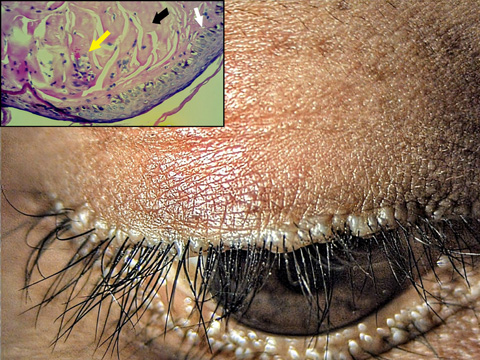
A 16-year-old girl presented at Aravind Eye Hospital, Chennai, Tamil Nadu, India, with a complaint of recurrent irritation in both eyes for the previous 2 years. On examination, she had characteristic beaded papules along both eyelid margins suggestive of moniliform blepharosis. Incisional biopsy revealed irregular acanthosis, deposition of eosinophilic material in the dermis (black arrow) and pinkish material around blood vessels and adnexa , confirming the diagnosis of lipoid proteinosis. Lipoid proteinosis is an autosomal recessive inherited disease caused by a homozygous or compound heterozygous loss-of-function mutation in the extracellular matrix protein 1 (ECM1) gene, located on chromosome 1q21, which encodes for glycoproteins essential for basement membrane and extracellular matrix structure integrity, skin adhesion, and protein-protein interactions. Moniliform blepharosis, characterized by beaded papules along the eyelid margins, is a pathognomonic finding present in about 50% of cases. The patient was managed by radiofrequency ablation of papules and topical lubricants.
Downloads
Article Details

This work is licensed under a Creative Commons Attribution-NonCommercial-NoDerivatives 4.0 International License.